
 In a digital world where customers are exposed to thousands of advertisements every day, traditional advertising alone is no longer enough to capture attention and build trust. People increasingly want to know what other customers think before they decide to buy a product or service.
This is why user generated content marketing has become an important strategy for modern brands.
From customer reviews and Instagram Reels to unboxing videos, testimonials, product demonstrations, and social media posts, user-generated content allows brands to showcase their products through the experiences of real people.
In this guide, we’ll explore what user generated content marketing is, why it matters, how it works, different types of UGC, how brands can create a successful UGC strategy, and how businesses can use UGC to strengthen their digital marketing campaigns.
What Is User Generated Content Marketing?
User generated content marketing, often called UGC marketing, is a marketing strategy that involves using content created by customers, users, or creators to promote a brand, product, or service.
Instead of a brand creating every piece of promotional content itself, UGC allows other people to demonstrate, review, recommend, or talk about the brand.
For example, imagine a skincare company launching a new sunscreen.
The company could create a professional advertisement showing a model applying the sunscreen. That’s traditional brand-created content.
Alternatively, the company could work with several creators or customers who create short videos showing:
- How they apply the sunscreen
- How the product feels on their skin
- How they include it in their daily routine
- Their personal experience with the product
- Why they would recommend it
The second approach is an example of UGC marketing.
The important difference is the perspective. Instead of hearing only from the brand, potential customers can see the product being used from a person’s point of view.
Why Is User Generated Content Marketing Important?
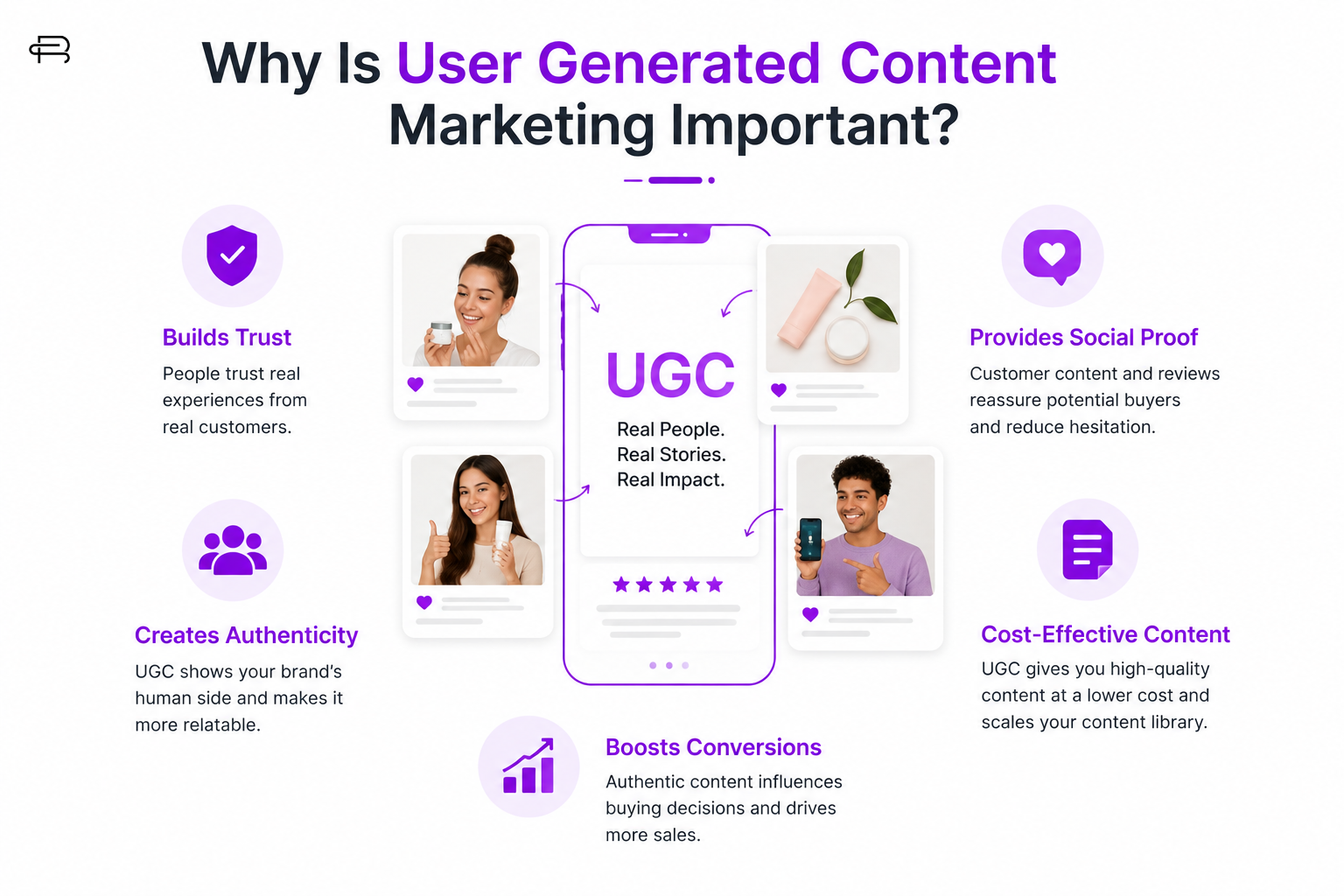 The internet has changed the way people make purchasing decisions.
Before buying something, customers may search Google, watch YouTube videos, browse Instagram, read reviews, and check comments. They want evidence that a product actually works for people like them.
UGC can provide that social proof.
1. UGC Builds Consumer Trust
Trust is one of the biggest advantages of user generated content marketing.
A traditional advertisement is clearly created by a company to sell something. UGC can feel more like a recommendation or personal experience.
For example, compare these two messages:
Traditional advertising:
“Our sunscreen provides lightweight protection and leaves your skin feeling comfortable.”
UGC-style content:
“I’ve been using this sunscreen every morning, and I really like how lightweight it feels.”
The second example sounds more conversational and personal.
That natural communication can help potential customers connect with the product.
2. UGC Makes Brands Feel More Authentic
People don’t always want perfect advertisements.
Sometimes, they want to see products in realistic environments and situations.
A creator filming a skincare routine in their bedroom, a customer reviewing a restaurant, or someone showing how they use a new gadget can make the content feel more relatable.
This is particularly useful for brands targeting younger audiences who spend significant time consuming short-form video content.
3. UGC Provides Social Proof
Social proof is the idea that people are influenced by the experiences and actions of others.
If potential customers see many people using and discussing a product, it can increase their confidence in the brand.
Examples of social proof include:
- Customer reviews
- Video testimonials
- Instagram posts
- Product ratings
- Unboxing videos
- Before-and-after content
- Customer photos
UGC allows brands to turn these experiences into marketing assets.
4. UGC Can Improve Advertising Performance
UGC isn’t limited to organic social media.
Brands can also use UGC-style videos in paid advertising campaigns.
For example, a brand could create several short videos featuring different creators and test them as Meta or TikTok advertisements.
Different hooks, creators, formats, and messages can then be tested to discover which content connects best with the target audience.
5. UGC Helps Brands Create More Content
One of the biggest challenges for brands today is maintaining a consistent flow of content.
Creating professional photoshoots and advertisements for every campaign can be expensive and time-consuming.
UGC gives brands another way to generate content.
A business can work with multiple creators and receive several pieces of content that can potentially be adapted for different marketing channels.
Different Types of User Generated Content
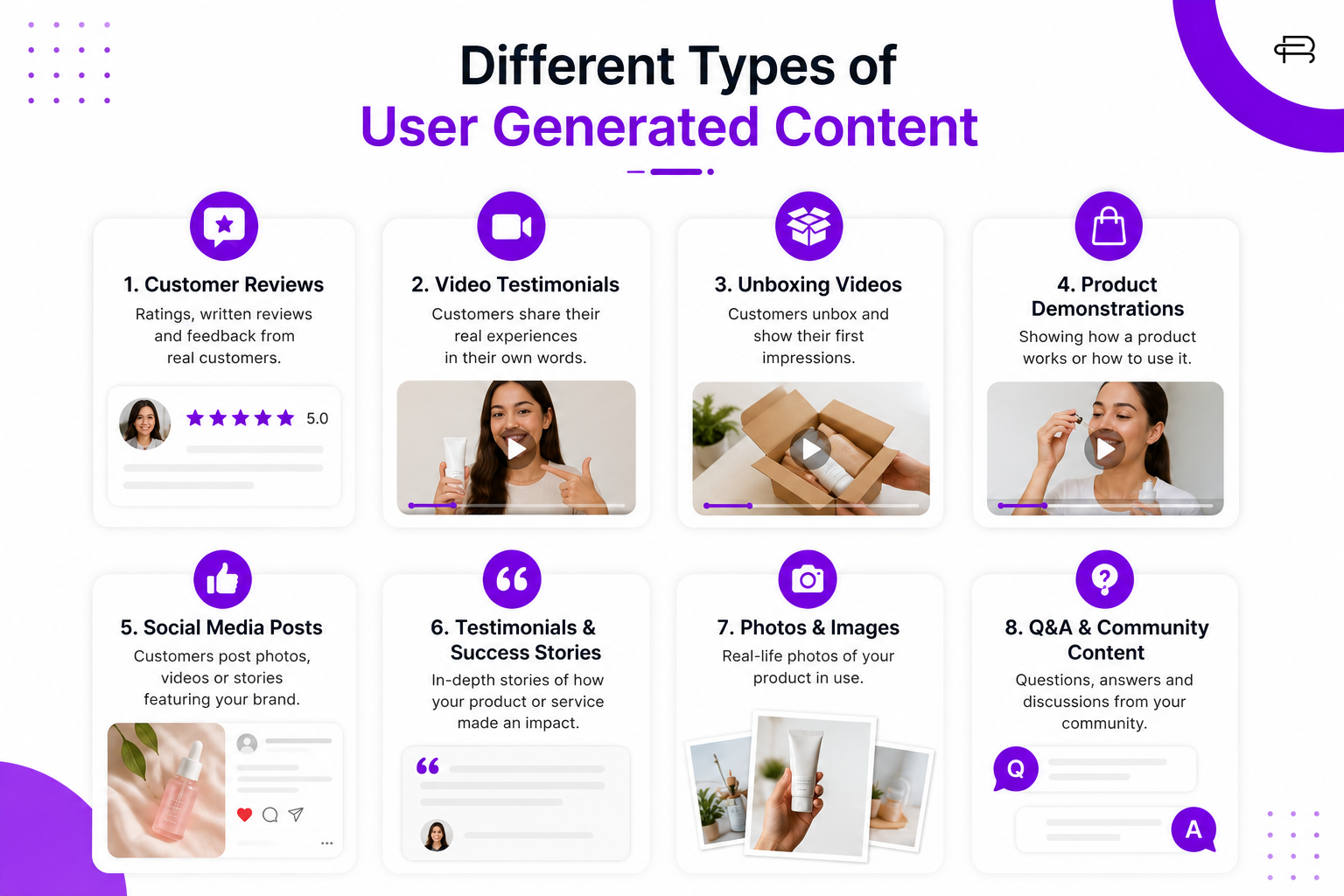
Different Types of User Generated Content
User generated content marketing isn’t limited to one particular type of content. Brands can use different forms of user-generated content to build trust, showcase products, and connect with their target audience.
From customer reviews to unboxing videos and social media posts, each type of content can play an important role in a user generated content marketing strategy.
Customer Reviews
Customer reviews are one of the most common and effective forms of user-generated content. They are an important part of user generated content marketing because they allow potential customers to see what other people think about a product or service.
Customer reviews can appear on:
- E-commerce websites
- Social media
- Product pages
- Review platforms
Written reviews are useful, but video reviews can add more personality and make the customer’s experience easier to understand.
For example, a skincare brand can use customer reviews in its user generated content marketing strategy to show how customers use and experience its products in their daily routines.
Video Testimonials
Video testimonials are another valuable format for user generated content marketing.
Instead of simply writing a review, customers can talk about their experience directly through video. This can make the content feel more personal and relatable.
For example:
“I started using this product two months ago, and it has become part of my daily routine.”
A genuine testimonial can help potential customers understand how a product fits into real-life situations.
Brands can use these testimonials on social media, websites, landing pages, and advertising campaigns as part of their user generated content marketing strategy.
Unboxing Videos
Unboxing videos show someone opening and exploring a product for the first time.
This type of content can be especially useful for user generated content marketing because viewers get to see the product from a customer’s perspective.
Unboxing videos can showcase:
- Packaging
- Product design
- Accessories
- Product features
- First impressions
Unboxing content is particularly popular for technology, beauty, fashion, lifestyle, and consumer products.
Brands can repurpose these videos across social media platforms and paid advertisements, making them a useful part of a broader user generated content marketing campaign.
Product Demonstrations
Product demonstrations show customers how a product works in real-life situations.
For example:
A technology brand could create a video showing how to set up a smart device.
A beauty brand could show how to apply a skincare product.
A kitchen brand could demonstrate how to use a new appliance.
This type of content can be highly valuable in user generated content marketing because potential customers can see the product in action before making a purchase.
Instead of simply telling people about product features, brands can use user generated content marketing to demonstrate how those features work in everyday situations.
Social Media Posts
Customers naturally share photos, videos, reviews, and experiences about products they purchase.
With appropriate permission and usage rights, brands can repost or repurpose this content as part of their user generated content marketing strategy.
For example, a fashion brand could feature a customer’s Instagram post showing how they styled a product.
This approach can help create a stronger sense of community while giving potential customers real examples of people using the brand’s products.
UGC Creators vs Customers
An important part of understanding user generated content marketing is knowing the difference between UGC creators and regular customers.
UGC doesn’t always have to come from people who have already purchased a product. Brands can also work with UGC creators to produce content specifically for their marketing campaigns.
A UGC creator is someone who specializes in creating content that looks and feels like authentic customer content.
They don’t necessarily need thousands of followers. Their main value comes from their ability to create engaging, natural, and relatable content that brands can use on their own social media channels, websites, and advertisements.
For example, a skincare brand could hire a UGC creator to produce:
- A product unboxing video
- A skincare routine video
- A product demonstration
- A testimonial-style video
The brand can then use these videos across different channels as part of its user generated content marketing strategy.
Why Are UGC Creators Useful for User Generated Content Marketing?
UGC creators can help brands produce content consistently without relying entirely on existing customers.
They can create content based on a specific brief while still maintaining a natural, user-focused style.
This makes UGC creators particularly useful for brands that want to scale their user generated content marketing campaigns and create multiple content variations for different audiences and platforms.
In short, user generated content marketing can include both genuine customer content and professionally created UGC-style content. The goal is to create relatable content that helps audiences understand, trust, and connect with a brand.
User Generated Content Marketing vs Influencer Marketing
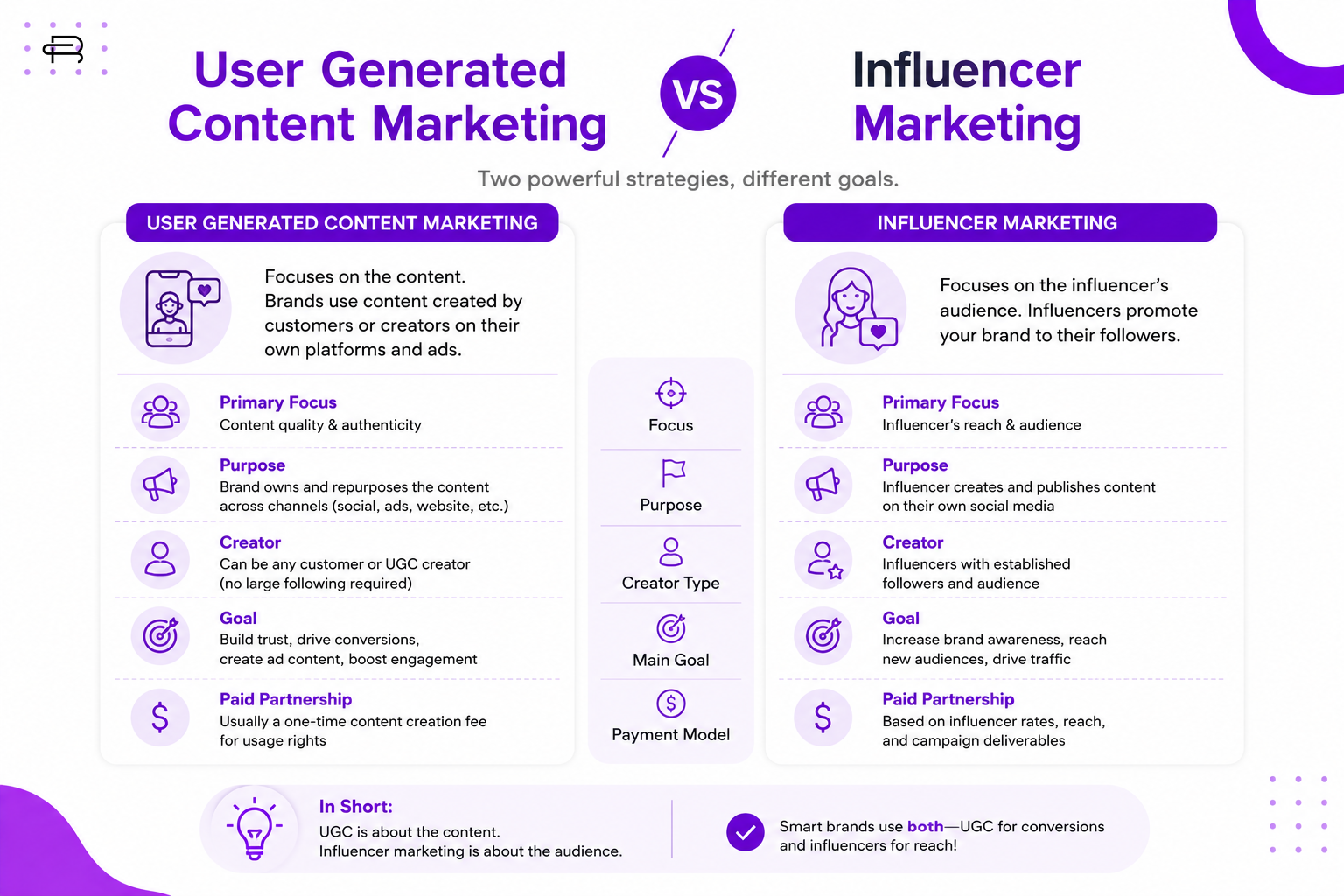 UGC marketing and influencer marketing are often confused, but they have different purposes.
Influencer Marketing
Influencer marketing usually focuses on the creator’s audience.
A brand collaborates with an influencer because that person has an established community of followers.
The influencer publishes the content on their own social media account.
UGC Marketing
UGC marketing focuses more on the content itself.
The creator may not have a large following. Instead, the brand pays them to create content that the brand can use on its own platforms.
For example:
Influencer campaign:
“Post this product review to your 100,000 followers.”
UGC campaign:
“Create three authentic product videos that our brand can use in our social media and advertising.”
Understanding this difference can help businesses choose the right strategy for their goals.
How to Create a User Generated Content Marketing Strategy
A successful UGC campaign needs more than simply asking people to create videos.
Brands should have a clear strategy.
Step 1: Identify Your Goal
Start by deciding what you want your campaign to achieve.
Your objective could be:
- Increasing brand awareness
- Building trust
- Increasing engagement
- Generating website traffic
- Increasing product sales
- Creating paid advertising content
- Launching a new product
Your goal will determine the type of UGC you need.
Step 2: Understand Your Target Audience
Before creating content, understand who you’re trying to reach.
Consider:
- Age
- Interests
- Problems
- Buying behavior
- Social media platforms
- Content preferences
For example, a skincare brand targeting young adults might benefit from short Instagram Reels showing a simple morning skincare routine.
Step 3: Select the Right UGC Format
Choose content formats based on your product.
For example:
Skincare:
Routine videos, tutorials, testimonials
Fashion:
Try-on videos, styling videos, outfit reviews
Food:
Taste tests, recipes, reaction videos
Technology:
Unboxing, tutorials, product demonstrations
Fitness:
Product demonstrations, workout content, progress stories
Step 4: Find the Right Creators
Look for creators who match your target audience and brand personality.
Don’t focus only on follower count.
Consider:
- Video quality
- Communication skills
- Authenticity
- Camera presence
- Creativity
- Editing ability
- Understanding of the product
A creator with 2,000 followers may create excellent UGC even though they aren’t a traditional influencer.
Step 5: Create a Clear Brief
Give creators enough information to understand your expectations.
A UGC brief can include:
- Brand introduction
- Product information
- Campaign objective
- Target audience
- Key benefits
- Required scenes
- Video duration
- Hook ideas
- Call to action
- Do’s and don’ts
- Submission deadline
However, avoid controlling every word.
Creators often produce better content when they have some creative freedom.
How to Create a High-Converting UGC Video
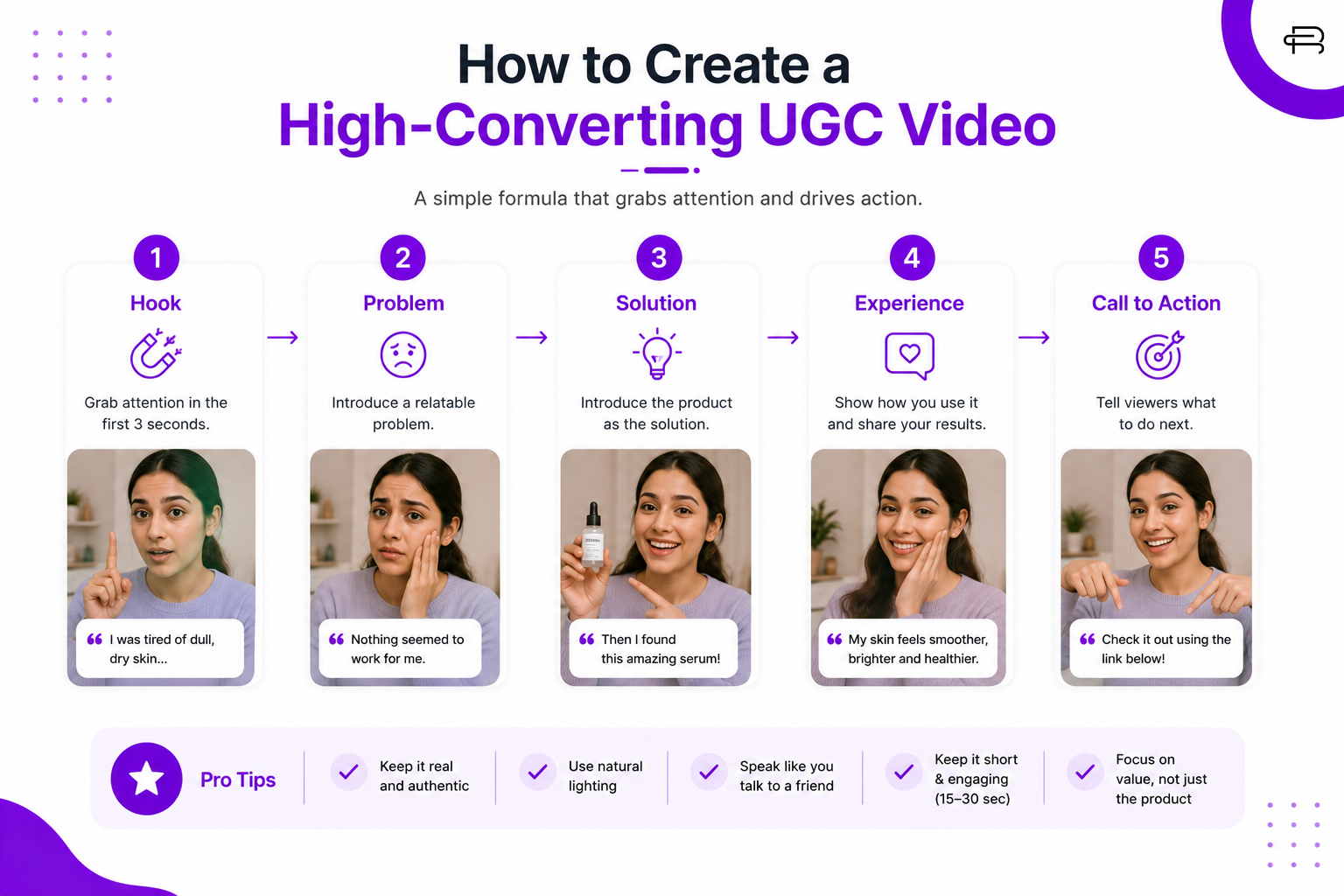 A simple UGC video structure can be:
Hook → Problem → Solution → Experience → CTA
Hook
The first few seconds need to capture attention.
Examples:
“Have you been struggling to find a sunscreen that doesn’t feel heavy?”
“I finally found a product that fits into my morning routine.”
Problem
Introduce a relatable problem.
For example:
“I didn’t like using sunscreen because many formulas felt uncomfortable on my skin.”
Solution
Introduce the product.
“Then I tried this lightweight sunscreen.”
Experience
Show how the creator uses the product and explain their experience.
Call to Action
Finish with a clear next step.
“Check it out if you’re looking for something similar.”
The exact structure can change depending on the brand and campaign, but the goal is to keep the content natural and engaging.
How Brands Can Use UGC Across Different Platforms
One of the biggest advantages of UGC is that a single piece of content can potentially be repurposed.
UGC works particularly well in:
- Reels
- Stories
- Carousel posts
- Product-focused content
Brands can use UGC for:
- Organic posts
- Video advertisements
- Product promotions
- Retargeting campaigns
TikTok
Short, authentic videos can be used to demonstrate products, tell stories, and respond to customer problems.
Websites
Brands can add UGC to:
- Homepage sections
- Product pages
- Landing pages
- Testimonials
Email Marketing
UGC can also be incorporated into promotional emails to add social proof.
The Role of AI in User Generated Content Marketing
 Artificial intelligence is creating new possibilities for content production.
AI tools can help marketers with:
- UGC script ideas
- Video concepts
- Content hooks
- Caption generation
- Editing
- Voiceovers
- Creative variations
- Ad concepts
AI can also help marketers produce multiple creative variations for testing.
However, brands should be careful when using AI-generated content.
If AI creates a fictional testimonial or makes a person appear to have personally used a product when they haven’t, presenting that as a genuine customer experience can be misleading.
The goal should be to use AI to improve the creative process while maintaining transparency and trust.
Common UGC Marketing Mistakes
1. Making Every Video Look Like an Advertisement
UGC works because it feels natural.
If every video contains excessive branding, scripted language, and polished production, it can lose that authentic feeling.
2. Choosing Creators Only Based on Followers
UGC is primarily about content creation.
A creator’s ability to produce relatable, engaging videos can be more relevant than their follower count.
3. Giving Creators an Extremely Rigid Script
Creators should understand the important brand messages, but they should also be allowed to communicate naturally.
4. Not Defining Content Usage Rights
Before using creator content in paid advertisements or other marketing channels, brands should clearly establish usage permissions and licensing terms.
5. Creating Content Without Testing
A single UGC video isn’t necessarily enough.
Brands can test different:
- Hooks
- Creators
- Video lengths
- Messages
- CTAs
- Visual styles
Testing helps marketers understand what resonates with their audience.
How to Measure UGC Marketing Success
Like any other digital marketing strategy, UGC should be measured using relevant KPIs.
Depending on the campaign, brands can monitor:
Engagement
- Likes
- Comments
- Shares
- Saves
Traffic
- Website visits
- Landing page visits
- Click-through rate
Conversion
- Leads
- Sign-ups
- Purchases
- Conversion rate
Advertising
- Cost per click
- Cost per acquisition
- Return on ad spend
The most important metrics depend on the campaign objective.
If your goal is awareness, reach and engagement may be important.
If your goal is sales, conversions and revenue are more meaningful.
The Future of User Generated Content Marketing
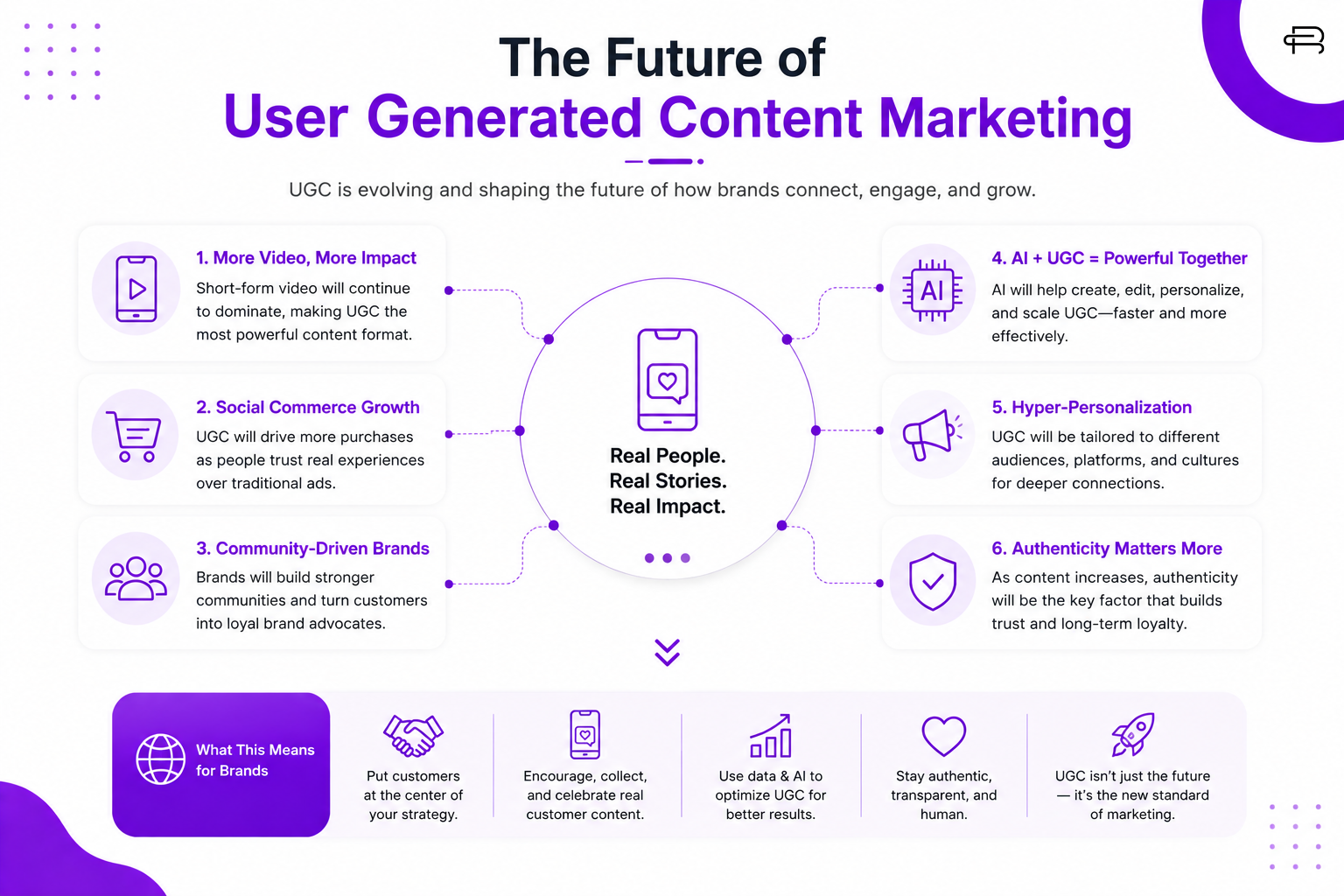 The future of user generated content marketing is closely connected to short-form video, creator economies, social commerce, and AI-powered content creation.
Consumers are increasingly discovering products through social platforms rather than traditional search alone. This creates opportunities for brands to use real-world demonstrations, creator content, customer experiences, and community-driven storytelling.
Brands that successfully combine UGC with strong storytelling and performance marketing can create content that is both relatable and commercially effective.
The key isn’t simply to create more content.
It’s to create the right content for the right audience at the right stage of the customer journey.
Conclusion
User generated content marketing has become a valuable strategy for brands that want to build trust, create engaging content, and connect with modern consumers.
From customer reviews and testimonials to professional UGC creators and AI-assisted content production, there are many ways businesses can incorporate UGC into their marketing strategy.
The most successful campaigns focus on authenticity, relevance, creativity, and measurable results.
Instead of simply telling customers why they should choose your brand, UGC gives you an opportunity to show how real people experience your product or service.
And in a crowded digital marketplace, that human connection can make a significant difference.